Every year, thousands of talented and hardworking CA students across Pakistan sit their ICAP exams fully prepared — and still do not get the result they deserve. Not because they did not study. Not because they lacked intelligence. But because they made avoidable mistakes that cost them marks they had genuinely earned.
After speaking with CA students who have sat multiple attempts and those who passed in their first try, a clear pattern of mistakes emerges. These are not random errors — they are the same mistakes repeated by students across every exam session.
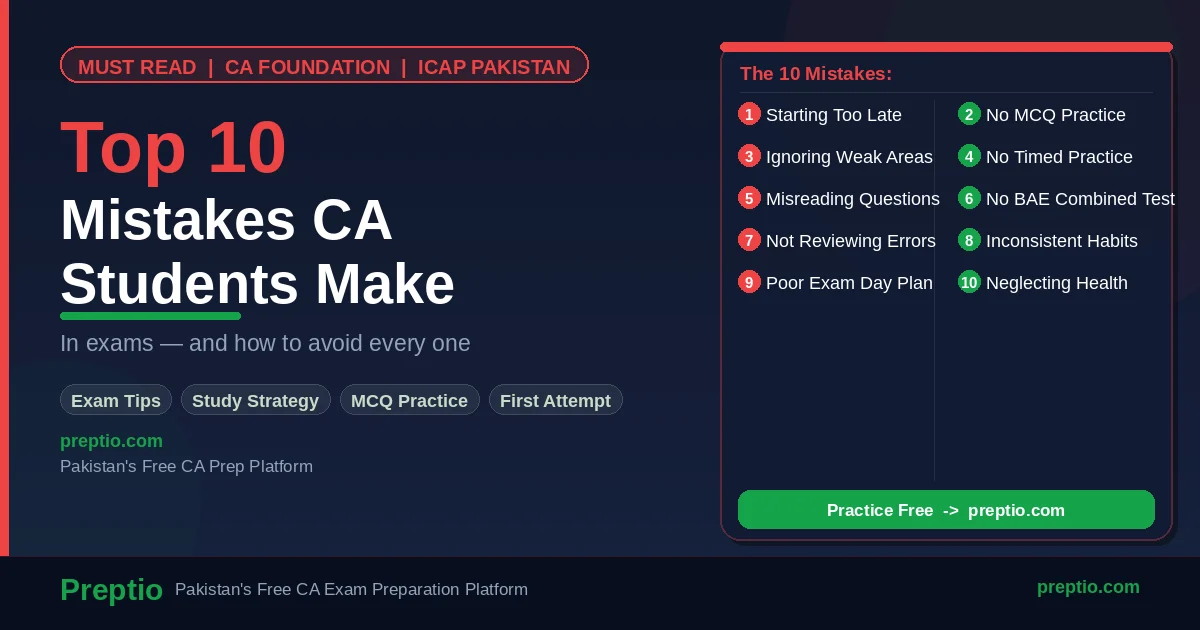
This article documents the top 10 most damaging mistakes CA Foundation students make in their exams and — more importantly — exactly how to avoid each one. Read this carefully. Some of these will feel uncomfortably familiar.
Practice Fundamentals of Accounting on Preptio
Test your knowledge with real CA exam questions — completely free.
Preptio Tip: Preptio is Pakistan's free CA exam preparation platform with 4,000+ ICAP-aligned practice questions. If you are reading this before your exam, start practicing at preptio.com — it is completely free.
Mistake #1: Starting Exam Preparation Too Late
This is the single most common and most devastating mistake CA students make. The CA Foundation syllabus is substantial. Fundamentals of Accounting alone requires months of consistent practice to master. Yet a significant number of students open their books seriously only four to six weeks before the exam.
The result is predictable: rushed reading, shallow understanding, no time for proper MCQ practice, and walking into the exam hall with a foundation built on panic rather than preparation.
How to Avoid It
- Start your preparation a minimum of four months before the exam date.
- Create a month-by-month study plan from Day 1 — not the week before the exam.
- Treat the exam date as fixed and non-negotiable from the moment you register.
- Begin MCQ practice from Week 1, even before you have finished reading the full chapter.
Important: There is no preparation strategy powerful enough to fix a three-month deficit in two weeks. Time is the one resource you cannot recover once it is spent.
Mistake #2: Reading Without Practicing MCQs
Reading your textbook feels productive. Highlighting key points feels like studying. But in an MCQ-based exam like CA Foundation, passive reading is only half of the preparation equation — and the less important half at that.
The ability to select the correct answer from four carefully constructed options — especially when three of those options are designed to confuse you — is a skill that only develops through practice. Students who read extensively but practice minimally consistently underperform relative to students who balance reading with regular MCQ practice.
How to Avoid It
- For every chapter you read, complete a minimum of 20 to 30 MCQs before moving to the next chapter.
- Practice MCQs without looking at your notes first — this tests real understanding, not memory of what you just read.
- When you get a question wrong, identify whether it was a concept gap, a reading error, or a calculation mistake. Each requires a different fix.
Preptio Tip: Preptio's chapter-wise practice mode lets you test each chapter immediately after studying it. Practice FOA, BAEIVI, BAEIV2E, and QAFB chapter by chapter at preptio.com
Mistake #3: Ignoring Weak Chapters Until It Is Too Late
Human nature drives us toward comfort. When you are studying and find Chapter 3 easy and Chapter 7 difficult, the natural instinct is to spend more time on Chapter 3 where you feel confident and less time on Chapter 7 where you struggle.
In an MCQ exam, this instinct is catastrophic. Every question carries equal marks regardless of which chapter it comes from. A student with 90% accuracy on eight chapters and 30% accuracy on two chapters will perform worse overall than a student with 70% accuracy consistently across all ten chapters.
How to Avoid It
- After every practice session, note which chapters have accuracy below 60%.
- Allocate at least 40% of your study time in the final month specifically to your weakest chapters.
- Practice weak chapters multiple times until your accuracy consistently exceeds 70%.
- Never enter the exam hall with a chapter you know is significantly weaker than the rest.
Important: Your strongest chapters will take care of themselves. It is your weakest chapters that determine whether you pass or fail. Spend your time accordingly.
Preptio Tip: Preptio shows your accuracy per chapter across all subjects. You can see instantly which chapters need more attention and target your practice precisely. Visit preptio.com to track your weak areas.
Mistake #4: Never Practicing Under Timed Conditions
Answering 50 questions at your own pace with no time pressure is a completely different experience from answering 50 questions in 75 minutes with a countdown clock running. Students who only ever practice without time constraints consistently make two critical errors in the real exam: they run out of time before completing the paper, or they rush through final questions carelessly under time pressure.
Exam time management is a skill. And like all skills, it only develops through deliberate practice.
How to Avoid It
- From Month 2 of your preparation onwards, always practice MCQs with a timer running.
- Target a maximum of 90 seconds per question for CA Foundation MCQs.
- Complete at least two full timed mock exams per subject before your actual exam.
- Practice the habit of moving on from difficult questions rather than spending 3-4 minutes on a single MCQ.
Preptio Tip: Preptio's timed mock exams simulate the real ICAP exam experience with a countdown timer, auto-submit at zero, and a detailed results breakdown. Practice free at preptio.com
Mistake #5: Misreading the Question
This is the most frustrating mistake because the student actually knows the answer — they simply answered a different question than the one asked. In MCQ exams, questions are carefully worded and a single word can completely change the correct answer.
Common misreading patterns include: missing the word 'NOT' in the question, confusing 'increase' with 'decrease', misidentifying which entity the question refers to, and reading the question stem correctly but misreading one of the answer options.
How to Avoid It
- Read every single question twice before selecting your answer. This takes approximately 10 extra seconds per question — a worthwhile investment.
- Underline or mentally highlight key words: NOT, EXCEPT, ALWAYS, NEVER, MOST LIKELY, LEAST LIKELY.
- Read all four options completely before selecting — even if you think you know the answer after reading Option A.
- In practice sessions, when you get a question wrong, check whether misreading was the cause.
Important: In post-exam analysis, students consistently identify misreading as the cause of 20 to 30 percent of their wrong answers. It is the most preventable mistake on this list.
Mistake #6: Skipping the BAE Paper Combined Practice
Many CA Foundation students practice BAEIVI and BAEIV2E as two completely separate subjects — which makes sense during the learning phase. But the actual ICAP exam tests both volumes in a single combined paper with a mixed ratio of questions from both.
Students who have never practiced the combined format find themselves caught off guard on exam day, uncertain whether they are spending proportionally the right amount of time on each section and unfamiliar with the mental shift between Vol I business concepts and Vol II economics concepts within the same paper.
How to Avoid It
- In the final four weeks before the exam, practice BAEIVI and BAEIV2E questions together in a single timed session.
- Based on real student reports, Vol II (ECO) questions are always equal to or more than Vol I (ITB) questions in the actual paper. Practice with this distribution.
- Build familiarity with switching between business and economics mindsets within the same exam.
Preptio Tip: Preptio's BAE Mock Test combines BAEIVI and BAEIV2E in the same ratio as the real ICAP paper, with a randomized distribution just like the actual exam. This is the only platform in Pakistan offering this feature. Practice it free at preptio.com
Mistake #7: Not Reviewing Wrong Answers
After a practice session or mock exam, most students do one of two things: they either feel good about their score and move on, or they feel bad about their score and move on. In both cases, they move on without properly analyzing what went wrong.
Every wrong answer contains specific information about a gap in your knowledge or your exam technique. Ignoring that information means you will make the same mistake again — in the next practice session, and potentially in the real exam.
How to Avoid It
- After every practice session, spend at least 15 minutes reviewing every question you answered incorrectly.
- For each wrong answer, identify the specific reason: wrong concept, calculation error, misread question, or guessed incorrectly.
- Write down any concept you got wrong and re-read that section of your textbook before the next session.
- If you keep getting the same type of question wrong, that chapter needs dedicated focused practice — not just more of the same questions.
Important: The students who improve fastest are not those who practice the most questions. They are the ones who learn the most from every question they get wrong.
Mistake #8: Inconsistent Study Habits
Studying for eight hours on Saturday, nothing on Sunday, two hours on Monday, and then nothing for four days before cramming again on the weekend is a pattern that feels like preparation but does not produce the deep learning required for exam success.
The brain consolidates memory during sleep through a process called memory consolidation. Consistent daily study — even in smaller amounts — produces significantly stronger long-term retention than irregular intensive sessions. This is not opinion. It is established neuroscience.
How to Avoid It
- Commit to a minimum daily study time — even 45 minutes is enough to maintain momentum.
- Study at the same time every day to build a habit that requires less willpower to maintain.
- On extremely busy days, do a minimum of 20 MCQ questions rather than skipping entirely.
- Track your study streak — the psychological effect of maintaining a streak is a powerful motivator to keep going.
Preptio Tip: Preptio tracks your daily study streak and awards milestone badges at 7, 14, 30, and 100 days. The streak system keeps you accountable and consistent. Start your streak today at preptio.com
Mistake #9: Poor Exam Day Management
Everything in this list so far has been about preparation. But exam day itself requires its own strategy. Students who are well-prepared but poorly organized on exam day consistently underperform relative to their actual knowledge level.
Common exam day mistakes include: arriving late and starting in a panic, spending too long on the first few difficult questions and running out of time at the end, not reviewing answers when time permits, and letting anxiety from one difficult question affect focus on subsequent questions.
How to Avoid It
- Arrive at the exam center at least 20 to 30 minutes before the start time. Rushing to an exam is one of the worst possible ways to begin.
- Scan the entire paper briefly at the start to gauge overall difficulty and identify questions you know immediately.
- Answer the questions you know confidently first — mark difficult ones and return to them.
- Never spend more than 2 minutes on a single MCQ during the first pass through the paper.
- If time permits at the end, review your answers — particularly on questions where you were uncertain.
- Do not let a difficult question spiral into anxiety. Move on, reset mentally, and focus on the next question.
Mistake #10: Neglecting Physical Health During Preparation
This mistake is consistently underestimated by students who believe that maximizing study hours is the only variable that matters. It is not. The quality of your cognitive performance — your ability to concentrate, recall information accurately, and think clearly under pressure — is directly and significantly affected by your physical health.
Students who sacrifice sleep to study more, skip meals to save time, and eliminate all physical activity from their routine during exam preparation consistently report worse exam performance than those who maintain basic health habits throughout their preparation.
How to Avoid It
- Sleep a minimum of seven to eight hours every night without exception — especially in the week before the exam.
- Eat proper meals including breakfast on exam day. Your brain requires glucose to function at full capacity.
- Take short breaks every 60 to 90 minutes during study sessions. Brief mental rest improves subsequent focus.
- Do some form of physical activity three to four times per week during your preparation period — even a 20-minute walk improves cognitive function.
- In the final week before the exam, reduce study intensity slightly. Burnout in the final week costs more marks than the extra study hours gain.
Important: The night before your CA Foundation exam: light revision for 30 minutes, prepare everything you need, eat a proper dinner, and sleep by 10 PM. That is the optimal final preparation strategy. Trust your months of work.
Bonus: The One Habit That Separates First-Attempt Passers
After everything on this list, there is one meta-habit that consistently separates students who pass CA Foundation in their first attempt from those who require a second try:
They track their performance data and adjust their preparation based on what the data shows — not based on what feels comfortable.
Students who know their accuracy per chapter, per subject, and over time can make intelligent decisions about where to focus their remaining preparation time. Students who practice without tracking are essentially studying blind — putting in the hours without knowing which hours are producing results.
Preptio Tip: Preptio's performance analytics shows your accuracy per chapter, accuracy trends over time, and your overall exam readiness score. You can see exactly where to focus and watch your readiness score improve as you practice. It is completely free at preptio.com
Quick Reference: The 10 Mistakes at a Glance
- Mistake 1: Starting preparation too late — Begin 4 months before exam day.
- Mistake 2: Reading without practicing MCQs — Practice 20-30 questions per chapter.
- Mistake 3: Ignoring weak chapters — Spend 40% of final month on your weakest areas.
- Mistake 4: Never practicing timed — Always use a timer from Month 2 onwards.
- Mistake 5: Misreading questions — Read every question twice before answering.
- Mistake 6: Skipping BAE combined practice — Practice BAEIVI + BAEIV2E together.
- Mistake 7: Not reviewing wrong answers — Analyze every incorrect answer after each session.
- Mistake 8: Inconsistent study habits — Practice daily, even if only 20 minutes.
- Mistake 9: Poor exam day management — Arrive early, manage time actively.
- Mistake 10: Neglecting physical health — Sleep 8 hours, eat properly, take breaks.
Final Words
None of the mistakes on this list require exceptional intelligence to avoid. They require awareness, discipline, and a willingness to be honest with yourself about how you are actually preparing — not just how much time you are spending.
The CA Foundation exam is genuinely achievable in the first attempt. ICAP designs it to be passed by students who prepare properly. The exam is not designed to trick you — it is designed to test whether you have put in the right kind of preparation.
Avoid these ten mistakes, practice consistently, and walk into your exam with genuine confidence. Pakistan needs excellent chartered accountants, and your journey starts with getting this foundation right.
About Preptio
Preptio is Pakistan's free CA exam preparation platform built specifically for ICAP CA Foundation students. With 4,000+ MCQ practice questions, chapter-wise practice, timed mock exams including the BAE combined paper mock, performance analytics, and exam readiness scoring — Preptio gives you everything you need to avoid every mistake on this list. Visit preptio.com to get started for free.