Financial statements are the heart of Fundamentals of Accounting. Every other topic in FOA either builds toward financial statements or flows from them. If you can prepare accurate, complete financial statements from a trial balance, you understand the core of the entire subject.
Yet financial statements are also the topic where CA Foundation students most commonly lose marks — not because the concept is impossibly difficult, but because the preparation approach is wrong. This guide gives you everything you need to master financial statements for your FOA exam.
Preptio Tip: Practice FOA financial statement MCQs on Preptio. Chapter-wise questions with instant feedback, completely free at preptio.com
Practice Fundamentals of Accounting on Preptio
Test your knowledge with real CA exam questions — completely free.
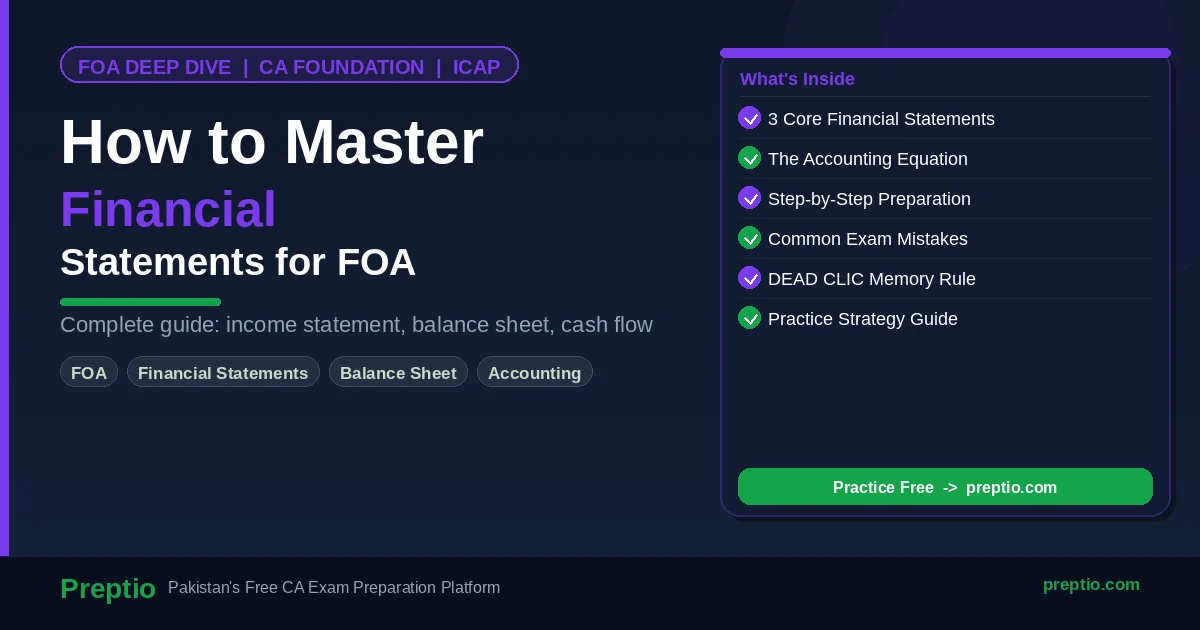
The Three Core Financial Statements
Before studying how to prepare them, you need to understand what each statement is actually telling you and why it matters.
1. Income Statement (Profit and Loss Account)
The income statement shows the financial performance of a business over a period of time — typically one year. It answers the question: did the business make a profit or a loss during this period?
Structure: Revenue minus Cost of Sales equals Gross Profit. Gross Profit minus Operating Expenses equals Operating Profit. Operating Profit adjusted for interest and tax gives Net Profit.
2. Balance Sheet (Statement of Financial Position)
The balance sheet shows the financial position of a business at a specific point in time — a snapshot on a particular date. It answers the question: what does the business own, what does it owe, and what belongs to the owners?
Structure: Assets equal Liabilities plus Equity. Non-current assets plus current assets on one side. Non-current liabilities, current liabilities, and equity on the other.
3. Cash Flow Statement
The cash flow statement shows the movement of cash in and out of the business during a period. It answers the question: where did the cash come from and where did it go? A business can be profitable but still run out of cash — understanding cash flow explains why.
The Accounting Equation - Your Foundation
Everything in financial statements flows from one fundamental equation that you must understand completely:
Important: Assets = Liabilities + Equity. This equation must always balance. If it does not, there is an error somewhere in your work. This is the most important concept in all of FOA.
Every transaction in double-entry bookkeeping maintains this balance. When a business buys equipment for cash, assets change on both sides — equipment increases, cash decreases — and the equation stays balanced. When a business takes a loan, assets increase (cash comes in) and liabilities increase (loan is owed) — balance maintained.
Step-by-Step: Preparing Financial Statements from a Trial Balance
In your FOA exam, you will typically be given a trial balance and asked to prepare one or more financial statements. Here is the exact process:
Step 1 - Identify Each Account Type
Go through the trial balance and classify every account as either: Revenue or Expense (goes to Income Statement) or Asset or Liability or Equity (goes to Balance Sheet). This classification is the most important step and the source of most student errors.
Step 2 - Prepare the Income Statement First
Always prepare the income statement before the balance sheet. You need the net profit figure from the income statement to complete the equity section of the balance sheet.
- Start with Revenue — all sales and income figures
- Deduct Cost of Sales to get Gross Profit
- List all operating expenses and deduct from Gross Profit
- Adjust for interest income and expense
- Calculate Net Profit before tax
Step 3 - Prepare the Balance Sheet
- List all non-current assets first — property, plant, equipment (net of depreciation)
- List current assets: inventory, receivables, prepayments, cash
- List equity: share capital plus retained earnings plus this year's net profit
- List non-current liabilities: long-term loans
- List current liabilities: payables, accruals, short-term borrowings
- Verify: Total Assets must equal Total Equity plus Total Liabilities
Preptio Tip: Preptio's FOA practice questions include financial statement preparation MCQs across all difficulty levels. Test your understanding chapter by chapter at preptio.com
The Most Common Financial Statement Mistakes in Exams
Mistake 1: Putting the Wrong Items in the Wrong Statement
A prepayment is a current asset, not an expense. An accrual is a current liability, not an expense. Drawings reduce equity — they are not an expense. These classification errors are the most common source of lost marks in FOA financial statement questions.
Mistake 2: Forgetting Adjustments
Trial balance figures often require adjustments before being placed in financial statements. Common adjustments include: depreciation of non-current assets, provision for doubtful debts, prepaid expenses, and accrued income or expenses. Missing adjustments is one of the top mark-losing errors.
Mistake 3: Not Checking the Balance Sheet Balances
Always verify your balance sheet at the end. If total assets do not equal total equity plus liabilities, do not move on — find the error. In a timed exam, spending two minutes finding an error is better than losing marks for an unbalanced balance sheet.
Mistake 4: Confusing Gross Profit and Net Profit
Gross profit is revenue minus cost of sales only. Net profit deducts all operating expenses from gross profit. Confusing these two in MCQ answers costs easy marks on questions that should be straightforward.
Memorisation Shortcuts That Actually Work
The DEAD CLIC Rule for Debits and Credits
Debits increase: Drawings, Expenses, Assets, Dividends. Credits increase: Liabilities, Income, Capital. If you remember DEAD CLIC you will never confuse debits and credits in double-entry questions.
Current vs Non-Current
Current means within one year. Non-current means beyond one year. A bank loan repayable in six months is current. A mortgage repayable over 20 years is non-current. The dividing line is always one year from the balance sheet date.
Practice Strategy for Financial Statements
- First, practice classifying accounts into income statement or balance sheet — do this with every trial balance you encounter
- Then practice preparing income statements from given data — do this 10 times until it is automatic
- Then practice preparing balance sheets — pay special attention to the equity section
- Finally, practice from full trial balances with adjustments — this is the complete exam-level skill
- Always verify your balance sheet balances before moving on
Important: The best way to master financial statements is to prepare them by hand repeatedly until the process becomes automatic. Understanding the theory without the practice of actually doing it will not produce exam-level accuracy.
Preptio Tip: Track your FOA chapter accuracy on Preptio and see exactly which financial statement topics need more practice. Visit preptio.com — free for all ICAP students.
About Preptio
Preptio is Pakistan's free CA exam preparation platform for ICAP CA Foundation students. Practice FOA financial statement questions and all other CA Foundation subjects with 4,000+ MCQs at preptio.com